
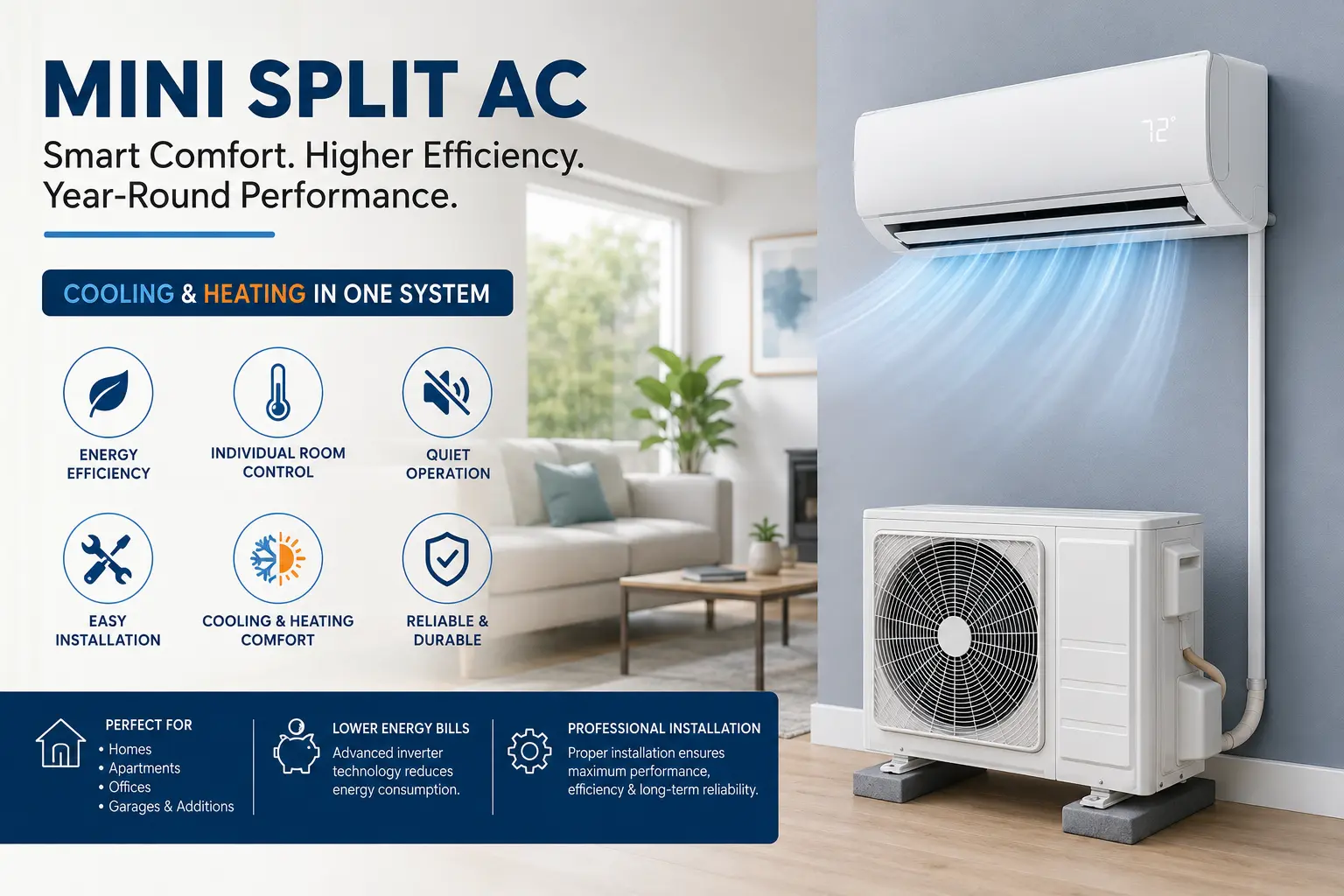
Mini split AC is one of the most effective and versatile cooling heating systems for residential and commercial properties. The mini split AC is an air conditioning system that is not connected to a ductwork system, but rather it pumps cooled or heated air directly into individual rooms, resulting in improved comfort, reduced energy costs, and exact temperature control.
From room to room, mini split AC systems provide an optimal combination of performance, energy efficiency and convenience, whether you are upgrading an older air conditioner, renovating your home, or installing a climate control system in a new room. Modern systems are programmed for both cooling and heating purposes, and a mini split AC and heat system is ideal for all year-round comfort.
Let’s start with the basics: What’s a Mini Split AC?
A mini split AC unit is a ductless air conditioning and heating system that comprises two major parts:
- Indoor air handler
- Outdoor compressor/condenser
During cooling, the indoor unit brings conditioned air into the room; during heating, the heat is removed from the room via the outdoor unit. There is no need for cumbersome ductwork to link the two units with refrigerant lines.
This basic design makes the ac mini split easier to install, quieter to run and much more energy-efficient than numerous traditional HVAC systems.
The working of a Mini Split AC System.
A mini split AC unit doesn’t produce heat, it just transfers it.
During summer:
- Indoor units take in warm indoor air.
- A refrigerant is used to remove heat to the outside.
- Cool air is circulated back into the room.
During winter:
- The process reverses.
- Outdoor air is used to remove heat.
- The warm air is brought into the house.
Mini split AC and heat systems are extremely efficient in almost all seasons with this technology.
The advantages of a Mini Split AC unit are numerous. There are a number of advantages to installing a Mini Split AC unit.
Superior Energy Efficiency
The major benefit of a mini split AC unit is the reduction in energy use. Up to 30% of conditioned air is lost due to leaks and inadequate insulation in traditional ductwork systems.
Very little loss of energy is lost since ductless systems introduce air directly into the room.
Benefits include:
- Save money on utilities each month
- Reduced electricity usage
- High SEER ratings
- Improved environmental performance
Individual Room Temperature Control allows for the separate regulation of each room temperature.
The mini split AC unit keeps each room at its own temperature.
This zoning capability is for:
- Bedrooms keep cooler at night time.
- The living rooms are comfortable throughout the day.
- Guest rooms are only in operation when occupied.
- Home offices are kept at a steady temperature.
Each indoor unit is independent of one another, delivering increased comfort without wasting unnecessary energy.
Easy Installation
The installation of mini split AC is much faster than the central air conditioning system.
For most installations just:
- A small opening in the wall.
- Refrigerant lines
- Electrical wiring
- Condensate drain
No ductwork required so installation is less intrusive and is frequently done in one day.
Quiet Operation
New mini split ACs are very quiet.
A ceiling fan may be quieter than an indoor unit, and is great for the following:
- Bedrooms
- Nurseries
- Libraries
- Offices
- Studios
One system for Heating and Cooling.
A mini split heat and AC system not only cools but also heats, as opposed to separate equipment.
This means that no need of:
- Window AC units
- Portable heaters
- Baseboard heating
- Space heaters
Home appliances are devices that are utilized at home. Home appliances are devices used at home.
Almost any property can use a mini split AC unit.
Common applications include:
- Single-family homes
- Apartments
- Garages
- Home additions
- Finished basements
- Attics
- Tiny homes
- Guest houses
- Workshops
- Commercial offices
They are particularly advantageous in situations where ducting would be costly or not feasible.
Types of Mini Split AC Systems
Single-Zone Systems
Designed to cool or heat one room.
Ideal for:
- Bedrooms
- Offices
- Garages
- Studios
Multi-Zone Systems
A multi-zone mini split AC system is one outdoor condenser with multiple indoor units.
Perfect for:
- Entire homes
- Multi-room apartments
- Offices
- Restaurants
The temperature can be set individually for each room.
Selecting the Best Mini Split Air Conditioner Unit
Choosing the correct size is crucial for functionality and effectiveness.
Common capacities include:
- Small (up to 400 square feet) 5,000 to 12,000 BTUs
- 150–250 sq ft 6,000 BTU
- 250–400 sq ft 9,000 BTU
- 400–550 sq ft 12,000 BTU
- 550–800 sq ft 18,000 BTU
- 800–1,200 sq ft 24,000 BTU
Too large systems cycle too often.
Under-sized systems have trouble keeping the home comfortable.
Professional sizing for optimum performance.
The installation process of Mini Split AC is quite simple and straightforward.
Correct installation of mini split ACs is important for longevity.
It is usually done in the following steps:
Site Assessment
Professionals determine:
- Room size
- Insulation quality
- Window placement
- Electrical requirements
Indoor Unit Placement
The indoor air handler is installed high on the wall, allowing for the best possible airflow.
Placement should avoid:
- Direct sunlight
- Furniture obstructions
- Heat-producing appliances
Outdoor Unit Installation
The condenser is mounted in:
- Concrete pads
- Wall brackets
- Ground mounts
The outdoor unit should have the correct ventilation.
Connecting Refrigerant Lines
Indoor and outdoor units are joined by copper tubing.
Vacuum testing the system prior to refrigerant release.
Electrical Connections
Licensed electricians ensure:
- Proper voltage
- Dedicated circuit
- Safe operation
- Code compliance
Testing and Commissioning
Once it’s in place, technicians check to make sure:
- Refrigerant pressure
- Airflow
- Drainage
- Temperature output
- Remote operation
To minimize maintenance problems with mini split AC units, follow these tips:
The mini split AC unit can last longer if its maintenance is done regularly.
Regular maintenance includes:
Clean Air Filters
Dirty filters impede airflow and efficiency.
Clean every:
- When used heavily, 2–4 weeks
Inspect Outdoor Unit
Remove:
- Leaves
- Dirt
- Grass
- Debris
Keep condenser clear of air.
Clean Indoor Coils
Cool air is lost when dust accumulates.
Cleaning annually will keep it efficient.
Check Refrigerant Levels
Low refrigerant affects:
- Cooling
- Heating
- Compressor lifespan
Never have refrigerant serviced by yourself or by anyone without an appropriate license from the HVAC industry.
Inspect Drain Lines
Where drains become clogged they can lead to:
- Water leaks
- Mold
- Odors
Periodic checks avoid expensive repairs.
Mini Split Heat and AC Efficiency
Another advantage that homeowners are interested in using mini split heat and AC systems is its amazing energy efficiency.
Look for:
- High SEER ratings
- High HSPF ratings
- ENERGY STAR certification
- Variable-speed inverter compressors
These technologies allow to save energy without compromising comfort.
Many new mini split ac systems have common features.There are common features of modern mini split AC systems.
Today’s systems include the latest in advanced technology such as:
- Wi-Fi connectivity
- Smartphone control
- Voice assistant compatibility
- Sleep mode
- Turbo cooling
- Automatic restart
- Self-cleaning functions
- Air purification filters
- Humidity control
- Energy-saving modes
These features provide enhancements to the convenience and optimise the efficiency.
Here are the indicators that it may be time to get a new air conditioner to replace the current one:
If your AC system is not performing well, you should consider upgrading to a mini split AC unit if it:
- Frequently breaks down
- Produces uneven temperatures
- Has had to increase energy expenditure.
- Uses outdated refrigerants
- Is over 10–15 years old
- Requires costly repairs
The replacement of the old HVAC system with a modern mini split AC system can help enhance comfort and lower operating costs.
Mini Split AC vs Traditional Central Air
| Feature | Mini Split AC | Central Air |
|---|---|---|
| Heat Pump and Fan | Mini Split AC | Central Air |
| Ductwork Required | No | Yes |
| Energy Efficiency (Excellent/Moderate) | Excellent | Moderate |
| Automated Door Control and Individual Zones to Whole House | Individual Zones | Whole House |
| Installation | Faster | More Complex |
| Maintenance | Lower | Higher |
| Minimum audible level for normal operation (dB) | < -25 dB | > 0 dB |
A ductless system is often the best option for many homes due to its flexibility and efficiency.
The installation cost of mini split air conditioners depends on a variety of factors.
The overall price of installing a mini split AC depends on a number of factors:
- Number of indoor units in a house or apartment.
- System capacity
- Installation complexity
- Electrical upgrades
- Wall construction
- Outdoor mounting requirements
- Quality and efficiency level and style.
The upfront cost of a window unit is typically more expensive than the initial cost of an RVS, but the energy savings can make up for the expense.
Frequently Asked Questions
How long does a mini split AC unit last?
If properly maintained, a good quality Mini Split AC will last from 15 to 20 years.
Is mini split AC and heat system a viable central HVAC alternative?
Yes. A multi-zone mini split AC and heat system can be used to heat and cool a whole home and keep each room cooler or warmer than the other.
How often are filters to be cleaned?
The air filter is usually recommended to be cleaned every 2 to 4 weeks, depending on how much air filtration is being used and the indoor air quality.
Are Mini Split AC Units Energy Efficient?
Yes. Today, most of the mini split AC units are inverter technology units and have a high efficiency rating, which means that they consume less energy than many traditional HVAC systems.
Is it possible to install a mini split AC myself?
While there are do-it-yourself AC installation kits, it is advised that professional installation of a mini split AC system is strongly recommended to ensure proper handling of refrigerant, safety of the electrical components and good performance of the system and also to ensure warranties are properly honoured.
Conclusion
For indoor comfort all year round, a mini split AC is a great solution that is efficient, reliable and versatile. From a single room ac mini split to a whole home mini split ac system or even a mini split heat and ac system for every season, these types of systems deliver remarkable efficiency, reduced operating expenses, and individual cooling. When properly sized and professionally installed, and maintained, homeowners can enjoy reliable cooling and heating for many years – while simultaneously boosting energy efficiency and enhancing indoor comfort. Visit website for more information.